|
MODEL 1876 PRAIRIE BELT – THIRD PATTERN - INFANTRY
MODIFICATION w/ INTERIOR INFANTRY ACCOUTREMENT STRAP –
VERY RARE AND EXCEPTIONAL INDIAN WARS CARTRIDGE BELT-
PUBLISHED AND WELL DOCUMENTED:
Just as the mounted troopers found
it necessary to create their Model 1876 Cavalry Modified
Prairie Belts, so too the foot soldiers had a need for
this Model 1876 Infantry Modified Prairie Belt for the
same reason – to enable them to carry the additional
accoutrements necessary to their mission. This belt is
one of the very few which survived as an exceptional
example of the frontier soldiers’ efforts to adapt the
standard issue equipment to meet their needs on
campaign.
One of the extremely few of
these modified Model 1876 Prairie Belts that survived
use in the field during the Indian Wars to appear today
in modern collections, this belt is the very same belt
pictured and discussed on pages 241-42 of American
Military and Naval Belts, 1812-1902 by R. Stephen
Dorsey, and was originally acquired from the author’s
research collection.

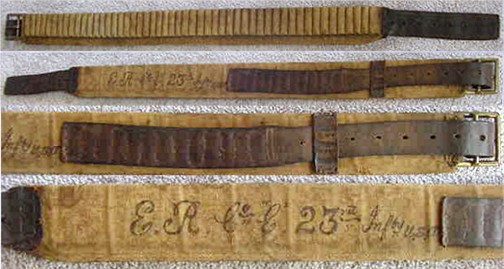
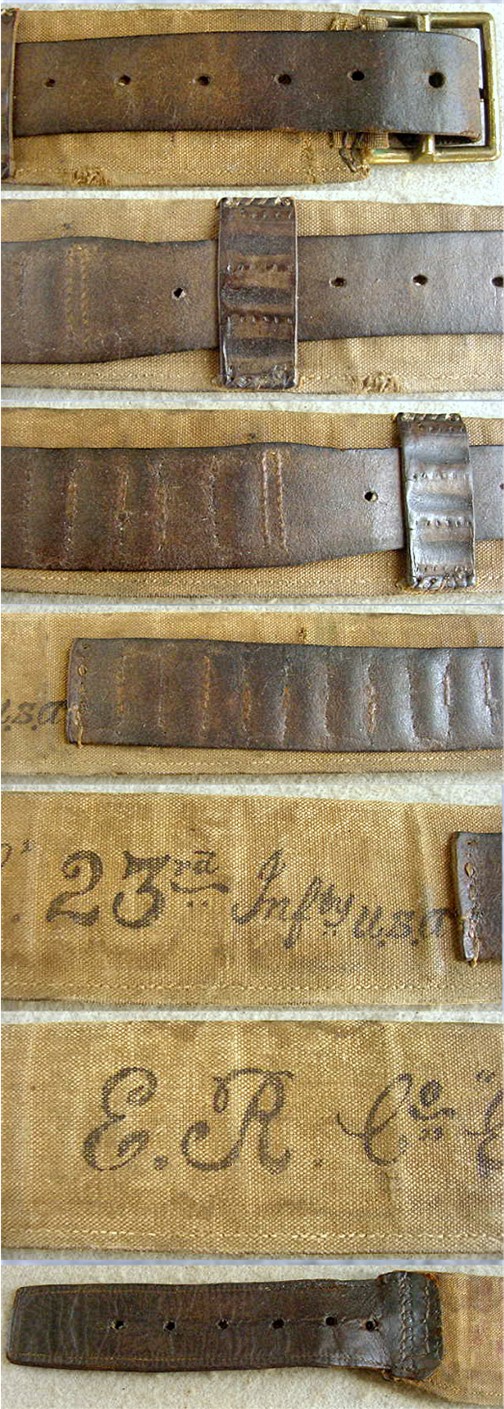
This Model 1876, Third Pattern Prairie Belt was modified
by the infantry soldier with the addition of a 1 ½”
wide, 20” long strap, secured on the inside surface of
the belt body between the 27TH and 28TH
cartridge loops with a single line of stitching. The
strap is supported and held against the prairie belt
body by a 1” wide leather strap with single lines of
stitching at the top and bottom edges of the belt. This
interior belt allowed the soldier to carry his bayonet
and scabbard and possibly a sheath knife without
interfering with the cartridge loops.
The applied strap and the
belt tongue both engage the brass buckle to hold both
leather billets in place when the belt was worn.
A particularly interesting feature is the apparent
source of the leather the soldier used for the interior
belt and the supporting strap. Both pieces of leather
clearly show lines of stitching – evidence the leather
was once part of a cartridge belt which carried .45
caliber cartridges. The soldier who modified this
prairie belt obviously had access to a Fair Weather
Christian cartridge belt and he repurposed that leather
to execute the addition to this belt.
That so few of these modified accoutrements survive
today can be easily explained when viewed through the
Ordnance Department’s process of issue and return. When
the units received new issues of current equipment and
returned the obsolete accoutrements and equipment to the
Ordnance Depots, those pieces that had been modified
such as this belt were looked upon by the Ordnance
Department personnel as damaged beyond repair, or the
necessary repairs to return the item to its original
configuration were not cost effective – especially since
it was obsolete equipment. It is very likely the bulk
of the modified pieces were condemned and destroyed with
the other unserviceable equipment. Belts such as this
specimen simply did not survive to be funneled into the
surplus sales that would eventually lead to the
collectors’ market, hence resulting in their rarity
today.
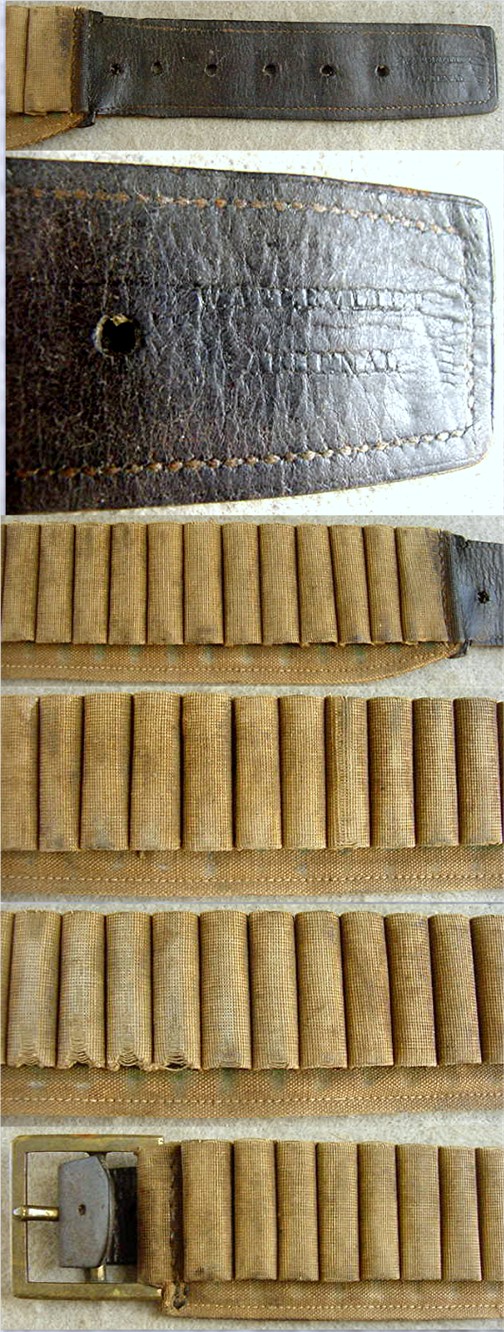
The belt has an overall length of 38 ¼”. As all of
these belts as issued were simply too long for the small
waisted cavalrymen of the period, the leather billets
were shortened to fit the soldier – in this case, the
billet has been shorted to 7 ¼” long.
The soldier also shortened
the length of the belt body at the buckle end of the
body, reducing the number of cartridge loops from the
standard 54 to 51.
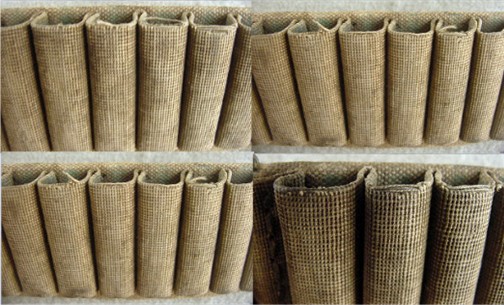
All of the loops are intact and show the expected wear
for such a field used belt along the top and bottom
edges of a few of the loops, but not so worn as to
collapse or lose their integrity or shape. The belt
body is very strong with no tears in the canvas on the
outside or inside surfaces, and the seam along the
bottom is fully intact.
The tongue is surprisingly smooth with a shiny leather
surface, no crazing, and only minimal flexing. The
“WATERVLIET ARSENAL” stamp is still legible on the tip
of the tongue, as is the inspector’s stamp “A. R. Smith”.
The added strap on the interior of the belt and the
support strap are likewise in very nice condition with
signs of use and flexing, but no crazing, retaining an
overall smooth surface. As noted above, both the
interior belt and the support strap still retain very
evident lines of stitching from their previous life as
part of a Fair Weather Christian Belt.
The interior surface of the belt bears a dramatic
inscription handwritten in ink which served to identify
the soldier who wore this belt – “E. R. CO
‘E’ 23rd Infty. U.S.A.”.
The small number of surviving
modified accoutrements serves as quiet testimony of the
efforts of the soldiers and the Ordnance Department to
adapt stocks of available accoutrements to meet the
needs encountered on the Frontier. In spite of the
number of these belts that must have been similarly
modified during the period, surviving examples such as
this one are rare and they are a fascinating field of
collecting in their own right. In addition to being a
well documented and published rare accoutrement, this
extraordinary belt is of the scope and quality to serve
as one of the center pieces in a collection of early
Indian War accoutrements and arms.
(0542)
$1875
|